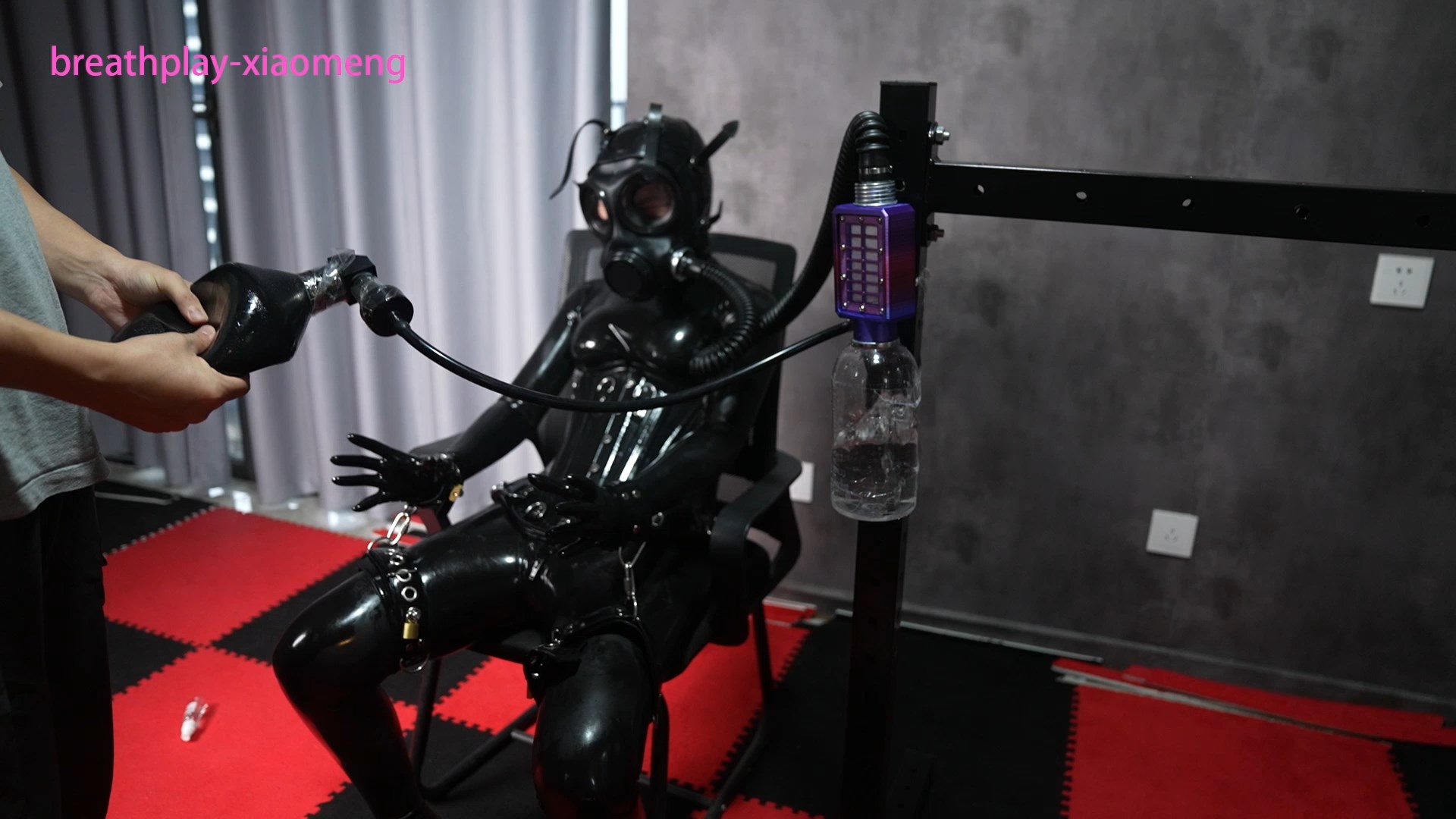
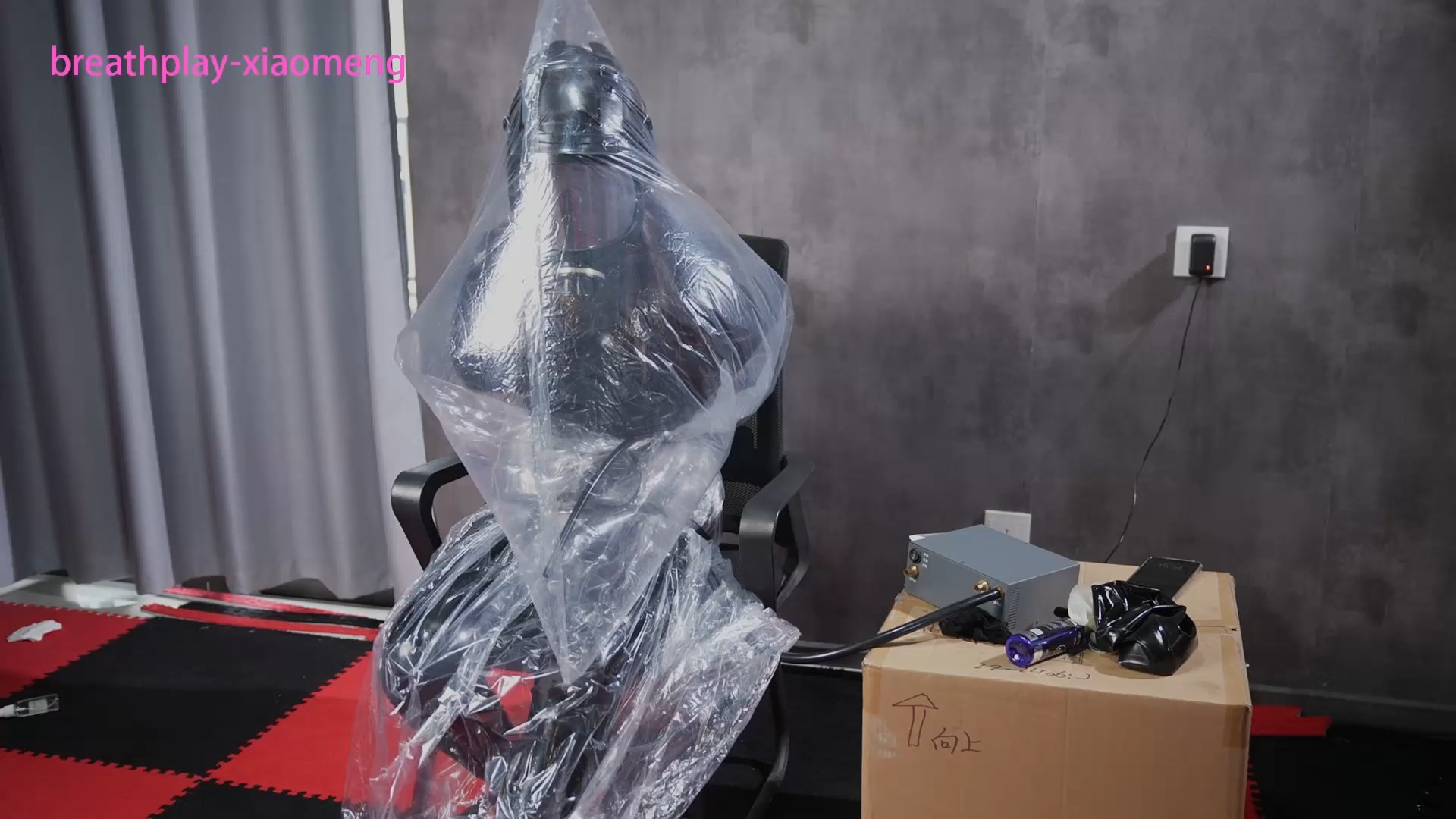
“Breathing is a natural, involuntary act. But what happens if both the air we inhale and breathing itself are controlled by external devices, switching breathing to “manual” mode? Xiao Meng experienced this today. First, Meng, wearing a full-body latex suit, was strapped to a chair and fitted with a latex breathing hood. The breathing chamber interface of the hood was connected to an air pump via a hose. From that point on, the air pump determined the quality of air Meng breathed. When the air pump was off, she could only rely on the limited air in her breathing chamber, causing oxygen to deplete rapidly and carbon dioxide concentration to rise rapidly. Turning on the air pump and refilling it could replenish the oxygen needed to sustain life, but it would prolong the suffering caused by high carbon dioxide concentrations. The only way to remove carbon dioxide was to switch the air pump to vacuum mode, evacuating the air from the breathing chamber. This forced Meng to hold her breath for a longer time, even though her oxygen levels were already very low. Obviously, keeping up with the machine’s rhythm in such a confined breathing chamber was extremely difficult. Therefore, in the next experiment, we fitted Xiao Meng with a larger restraint device: a full-body plastic bag connected to the air pump. While the space was indeed larger, when the air pump switched to exhaust mode, Xiaomeng’s entire body was sucked into the vacuum, making her feel even more cramped and not significantly improving her condition. Finally, we removed the machine and demonstrated a meticulously designed respirator to Xiaomeng and the audience. The system’s airway is: resuscitation bag—air reservoir—pressure valve—gas mask inlet. This pressure valve is a completely new device. Previously, when using resuscitation bags, we used a spring-loaded check valve, which relied on the pressure difference on both sides of the valve to work, but it was difficult to find the right threshold. If the threshold was too high, pressing the resuscitation bag would be very difficult; if the threshold was too low, the negative pressure generated by inhalation alone would open the valve, causing the resuscitation bag to malfunction. To solve this problem, we collaborated with KENZE to design this pressure valve, whose opening and closing depend solely on the positive or negative pressure of the air pressure in the tubing relative to the external atmospheric pressure. Pressing the resuscitation bag creates positive pressure in the tubing, opening the valve; not pressing and inhaling creates negative pressure in the tubing, closing the valve. This perfectly simulates a scenario where breathing depends entirely on manually operating the air bag. Now, let’s see how Xiaomeng masters this “manual” breathing technique! By the way, the bubble bottle is positioned so the audience can clearly see whether air is flowing into the gas mask through the tube. Of course, manual breathing alone can be boring. So, what happens when you add the stimulation of the FUNF rotor’s high-speed mode (random intensity, rhythm, vibration, suction, and electric shocks), constantly pushing Xiaomeng to orgasm? Will she forget to control the airbag in sync with the pleasure? Can she still maintain self-control and manually control the airbag?”
XMG161.mp4
Size 1920×1080
Length 45:13
Video codec H264, 4997 Kbps
Audio codec AAC, 256 Kbps
Container MP4
Filesize 1.7 GB
Download: