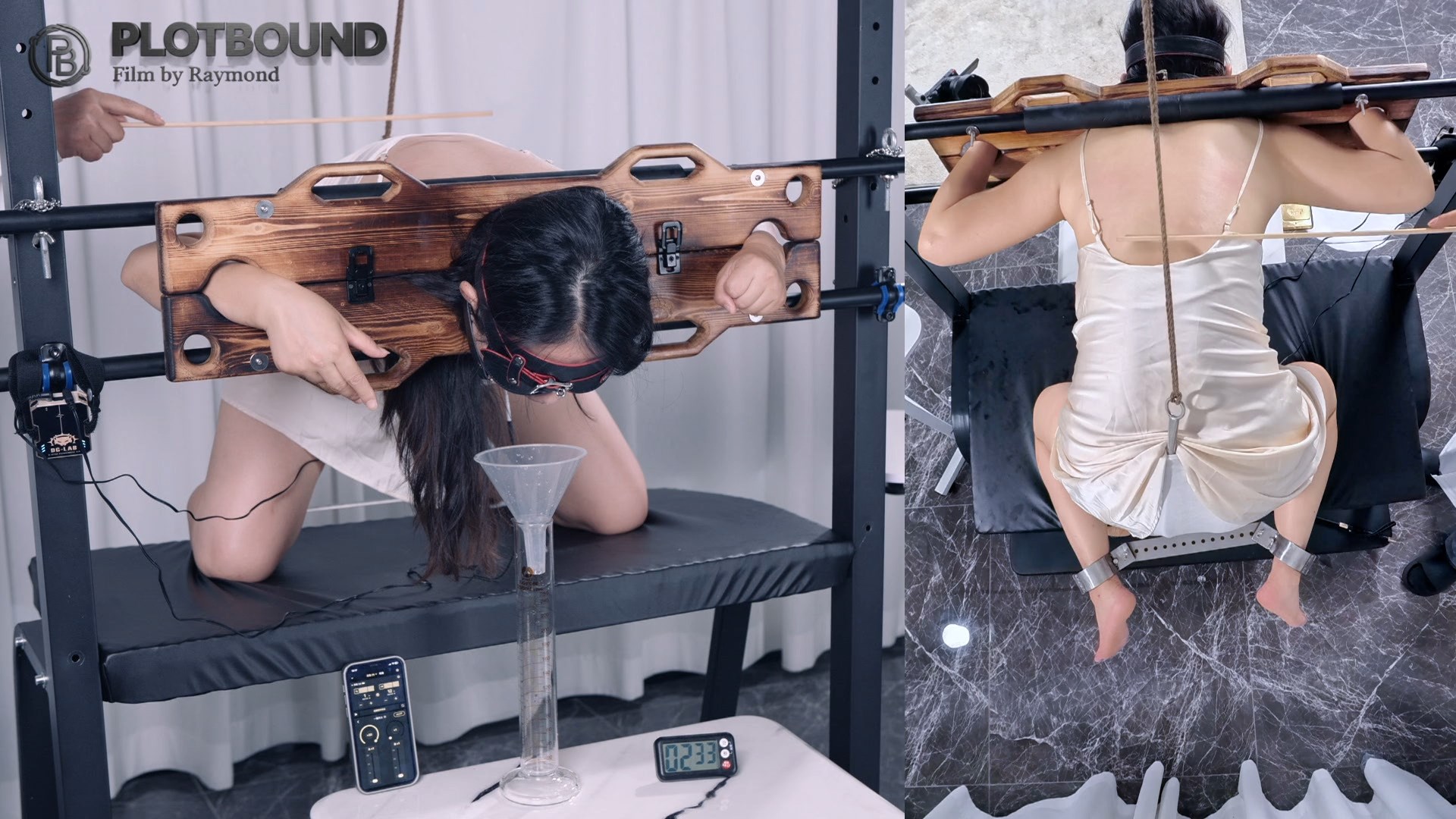

“A recent experiment investigated the effect of different gags on saliva production. In this experiment, Ms. Echo, as the volunteer, was fixed in a very torturous position, subjected to continuous electric shocks, and continuously whipped and tickled on her feet and armpits. Nine different gags were used to collect her saliva. Each gag lasted for 5 minutes. Although the prolonged and complete confinement caused Ms. Echo considerable pain, especially the repeated, rapid whipping of the same area and the scratching of her armpits, which were extremely uncomfortable, she persevered for the sake of the experiment. Due to the length of the experiment, even after deducting unnecessary recording time, it still lasted approximately two hours, and therefore is being released in two parts. This video is the first half of the experiment report, including the following: 1. Reading the informed consent form to Ms. Echo and having her sign it. 2. The setup process before the experiment: Ms. Echo knelt on the restraint frame, her front secured with a wooden handcuff, her back with metal hooks, and her ankles secured with metal handcuffs. The installation of the electric shock device. 3. The testing process of the first five props, each set of props taking approximately 11 minutes to test, including 5 minutes of footage from camera positions 1 and 2, 5 minutes of close-up footage from camera position 3, and approximately 10 seconds of test results. The following is the full text of this research report: I. Research Background In the past two years, I have received numerous letters from enthusiasts in the field, requesting more videos of drooling caused by using props to gag the mouth. This indicates that drooling caused by props is a topic with a certain audience. Currently, there are many types of mouth-gagging props on the market, and whether different props have different effects on the amount of drooling is a topic worthy of research. II. Feasibility Analysis To ensure the validity of the experimental results, it is necessary to ensure that different props function under the same conditions. Therefore, this experiment will design a specific fixation method to completely immobilize the subjects. Simultaneously, to make the experimental results more significant and to differentiate the effects of different props, each set of props will employ multiple methods to promote drooling, including immobilization in a painful manner, continuous electric shock, random whipping of various parts of the body at irregular intervals, and random tickling of the soles of the feet and armpits. Furthermore, the duration of each prop’s effect will be the same, with a dedicated timer timing each prop for 5 minutes. III. Ethical Analysis The subjects in this experiment are voluntary volunteers; there is no transaction or coercion involved. Before the experiment begins, the author will read the informed consent form to the participants. The informed consent form contains the entire plan of the experiment, including the fixation method, the facilitating methods that may cause pain and suffering, and all props used in the experiment. Participants will also be informed that the entire process of the experiment will be recorded and the records will be publicly released. Participants must sign the informed consent form before the experiment begins. IV. Volunteer Information Name: Huiyin; Gender: Female; Age: Confidential; Education: Master’s Degree; Occupation: Teacher; History of Sudden Illness: None. V. Experimental Grouping This experiment screened a large number of mouth-blocking props, eliminating types that do not cause drooling and completely sealed types that prevent drooling. Representative props were then selected from similar types. Ultimately, nine props were chosen and divided into the following four groups: a) Control Group The control group used one prop: a common disposable dental mouth opener. This prop is only used to prevent the lips from closing, allowing saliva to flow out naturally. This prop has no blocking function and does not produce any facilitating effect. Therefore, as a control group, the amount of saliva expelled from the subject’s mouth under normal conditions was tested; b) Gag Ball Group: Two representative props were selected for this group: a silicone gag and a bamboo cangue. The characteristic of this group is that it provides shallow gag and prevents the mouth from closing; c) Mouth Opener Group: Two representative props were selected for this group: a metal ring mouth opener with a tongue depressor and a caliper-type mouth opener. The characteristic of this group is that it is hollow and has no gag function, but it can prevent the gag from closing; d) Metal Restraint Group: Two representative props were selected for this group: a simple tongue depressor and a special stainless steel metal head cage. The characteristic of this group is that it is made entirely of metal and can tightly constrict the face and head while gagling, bringing a strong sense of restraint. The simple tongue depressor not only functions as a duckbill but also tightly constricts the mouth. The special stainless steel metal head cage, while restraining the entire head, also includes a hollow steel tube with a diameter of 32mm and an insertion depth of 30mm into the mouth. e) Deep Throat Group: This group selected two representative props: a deep throat gag with a thin silicone cylindrical protrusion and a professional deep throat gag with a 33mm thick protrusion. Measurements showed that the cylindrical protrusion of the deep throat gag reached a depth of 80mm from the gag to its deepest point, and 100mm from the lips to its deepest point; the professional deep throat gag, adjusted to level 2, reached a depth of 70mm from the gag to its deepest point, and 90mm from the lips to its deepest point. Although the professional deep throat gag, at level 2, was 10mm less deep, it was thicker and harder. VI. Test Method a) Fixation Method: The test subject was fixed to a special fixation frame. The subject was required to kneel on the frame, with the front secured by a straight-headed handcuff and the back by metal hooks, forming an immobile triangular fixation structure. Simultaneously, the subject’s ankles were rigidly fixed by straight-headed stainless steel handcuffs. This fixation method ensured the subject was completely immobilized while also causing significant discomfort, thus promoting saliva production. Furthermore, this posture also allows the subject to remain face down, facilitating the collection of saliva. To ensure the accuracy of the experimental data, the subject was fixed in this manner throughout the entire experiment. b) Methods of Inducing Saliva Production To make the experimental results more significant, the author set up various methods of torture to induce saliva production in the subject. First, the subject was subjected to random electric shocks at levels ranging from 1 to 40, with the shock sites being the groin and chest. Additionally, during the experiment, the author continuously and randomly whipped, tickled the soles of the feet, or tickled the armpits of various parts of the subject’s body. c) Measurement Method During each test, the subject’s saliva was collected in a graduated measuring cup over a 5-minute period from start to finish. After each test, photos and videos of the two cups were taken to record the saliva volume for subsequent measurement comparison. To ensure the accuracy of the experimental results, the measuring cups were thoroughly cleaned after each test before the next test was conducted. d) Recording Method This experiment was recorded using three cameras. Camera 1 was positioned directly in front of the subject, providing a panoramic view of the entire experiment. Camera 2 was positioned directly above the subject, providing a bird’s-eye view of the entire process. Camera 3 was positioned slightly to the left and slightly in front of the subject, focusing on the subject’s face and recording the drooling process in close-up. To streamline the recording time, cameras 1 and 2 were combined and spliced together, while camera 3, as a key close-up shot, was stored separately. Each set of experimental footage will consist of approximately 10 minutes: 5 minutes of spliced footage from cameras 1 and 2, 5 minutes of close-up footage from camera 3, and approximately 10 seconds of video and photos showcasing the experimental results. VII. Interviews After the experiment, the subjects were interviewed to understand the effects of different gagging tools and various forms of torture from their subjective perspectives.”
Raymond151.mp4
Download: